When I wrote about stablecoins on Day 1, I was just trying to make sense of things.
I understood the basic idea: digital money that stays around $1.
But now that I’m halfway through this 100-day journey, I wanted to go deeper. Not just what stablecoins are, but how they actually work behind the scenes.
So I tried something new.
I used a research tool called NotebookLM.
And honestly… I loved it.
Instead of drowning in long research papers and dozens of open tabs, I uploaded a stablecoin toolkit and let NotebookLM help me explore it. It can summarize reports, create flashcards, generate visual explanations, and even turn the material into conversations.
It felt like having a super nerdy study buddy sitting beside me saying:
“Okay Joy, here’s the important part. Let’s unpack this together.”
And the things I learned were fascinating.
For example, stablecoins are already moving trillions of dollars every year. Some research even shows that they process more yearly transaction volume than major global payment networks.
Another surprising thing? About 80% of crypto trading pairs use stablecoins. That means when people trade crypto, stablecoins are usually the bridge between assets.
In other words, they’re not just another token.
They’re the connective tissue of the crypto economy.
One of the visuals NotebookLM generated showed stablecoins as a bridge between traditional finance and the blockchain world.
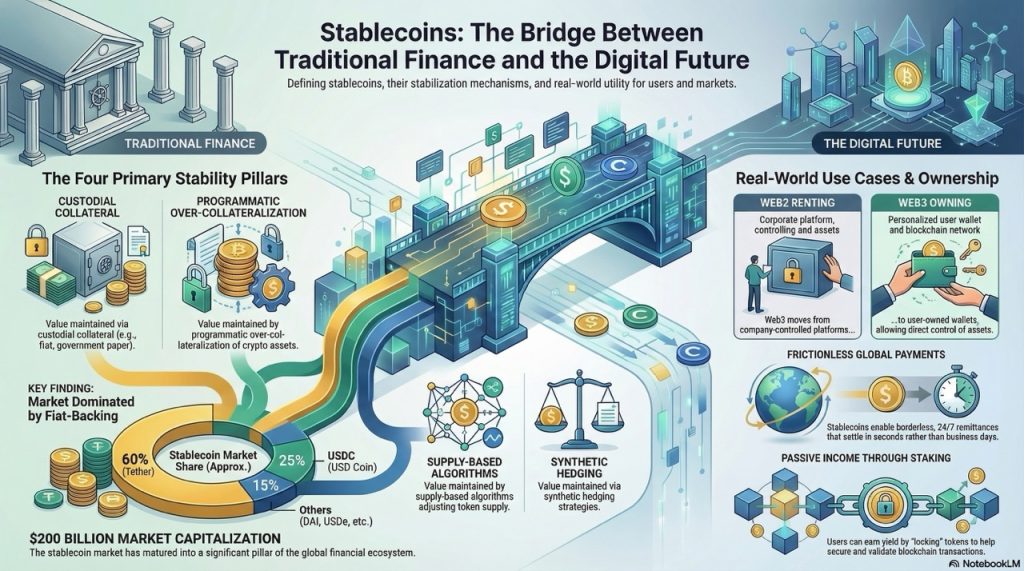
Banks and fiat money on one side.
Crypto and smart contracts on the other.
And stablecoins sitting right in the middle, connecting the two.
The more I study this space, the more I realize something funny.
Stablecoins might be the most boring part of crypto.
But they might also be the most important.
Why I’m Excited About Tools Like NotebookLM
One thing I’ve noticed during this 100-day challenge is that crypto can feel overwhelming at first.
Whitepapers.
Technical terms.
Charts everywhere.
But tools like NotebookLM make learning feel different.
It helped me turn heavy research into something I could actually digest. I could ask questions, generate summaries, and see visual explanations that made the ideas click faster.
For someone like me who’s learning in public and trying to explain crypto in simple language, it honestly feels like having a research assistant in my pocket.
And that makes the whole journey even more exciting.
Because suddenly, complicated topics like stablecoins don’t feel so intimidating anymore.
They just feel like another puzzle waiting to be understood.
Leave a Reply