One thing I quickly learned working in derivatives research is this:
when the market moves suddenly, it’s rarely just price…
it’s liquidations.
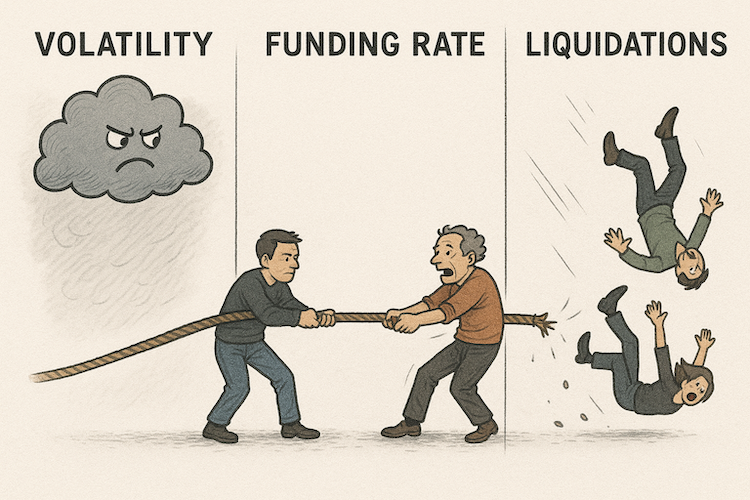
If volatility is the market’s mood, and funding rate is the tug-of-war between traders, then liquidations are the moment the rope snaps and people start falling one by one.
Liquidations explain the dramatic moves that make beginners panic,
those sudden, vertical candles that don’t look human at all.
Today, I finally understood why.
What are liquidations?
Liquidation happens when a leveraged position no longer has enough collateral to stay open.
In simple terms:
You borrowed money to trade.
The market moved against you.
Your account can’t handle the hit.
So the exchange steps in and forcefully closes your position.
It’s not personal.
It’s math.
Perp trading gives you control over a bigger position than your capital…
but the moment the market swings too far,
your “amplified exposure” becomes “amplified loss.”
Liquidations are the system’s way of preventing you from going negative.
Why liquidations move the market
Here’s something I didn’t understand until I started doing deeper research:
One liquidation triggers more liquidations.
It’s a domino effect.
- A trader gets liquidated →
- Their position is force-closed →
- That forced order pushes price further →
- Which liquidates the next over-leveraged trader →
- And so on…
This chain reaction is why you see:
- sudden long squeezes
- sudden short squeezes
- unexpected “wicks”
- violent candles
- fast market drops or spikes
Most beginners think “whales dumped!”
But often…
it’s just liquidation math collapsing on itself.
What I see at work that beginners don’t see
In derivatives research, we track:
- liquidation levels
- liquidation clusters
- leverage imbalances
- open interest combined with funding
- where traders are most exposed
And once you see it, the market makes more sense.
The big moves aren’t emotional.
They’re mechanical.
Liquidations are auto-executed, non-negotiable, instant.
The system doesn’t wait for you to think.
It just fires.
And that’s why the charts sometimes look like panic.
It is panic, but automated.
A Base moment that made this easier to understand
Earlier today, I transferred a small amount of USDC to Base to observe liquidation events in real time.
Because the chain settled instantly, I could watch the movement without lagging behind.
During sharp candles, every second matters.
If your transaction is delayed, the liquidation wave is already over by the time you see it.
On Base:
- no heavy gas
- no delays
- no waiting for confirmations
- no “please don’t fail” stress
Just real-time observation of liquidation behaviour.
It didn’t make liquidations less scary,
but it made them easier to study without feeling helpless.
Mom Analogy, Liquidations as the “I told you so” moment
Imagine your kid insisting they can pour juice “all by themselves,”
even if the cup is dangerously full.
You let them try.
You warn them.
You hover near the table…
But the moment the juice tilts too much,
gravity takes over.
The spill happens instantly.
No time to stop it.
No time to think.
That’s liquidation.
The system steps in, quick, automatic, unforgiving, to prevent an even bigger mess.
Why liquidations changed how I read charts
Before, a sudden candle felt like chaos.
Now, I pause and ask:
- “Was this a long squeeze?”
- “Did over-leveraged shorts get wiped out?”
- “Was this a liquidation cluster getting hit?”
- “Is this move sustainable, or just mechanical?”
Liquidations reveal whether price movement is real conviction…
or just forced selling.
And trust me, most dramatic moves are forced.
Not brave.
Not planned.
Just math clearing out risk.
Takeaway
Liquidations taught me that sharp market moves don’t always mean smart traders or dumb traders, sometimes it’s just the system cleaning up risk.
Here’s the truth:
If you understand liquidations, you stop fearing big candles… and start reading them.
You begin to see structure, not chaos.
Liquidations can be scary at first, but once you understand them, you’ll never look at a sudden candle the same way again.
Which one should I break down next?
Implied Volatility (IV) or The Greeks?
Tell me, and I’ll make it mom-friendly.
Leave a Reply